 Brand Strategy & Design
Build the brand before you build the website
Here's a pattern we see constantly.
A business launches a website, starts posting on social media, and runs some ads. Six months in, the results are underwhelming. The traffic isn't converting. The content feels off. Nobody seems to understand what makes the business different.
The instinct is to fix the website. Or try a new agency. Or spend more on ads.
But nine times out of ten, the real issue is earlier than any of that. The brand itself was never properly defined.
Websites, social media, and advertising don't create your brand. They communicate it. If there's nothing clear to communicate, no amount of spend will fix that.
What it means
Brand positioning — and why it matters
Brand positioning is how your business sits in the mind of a customer. Not what you do — but how they perceive you relative to every alternative they could choose instead.
Strong positioning answers four things clearly:
- Who exactly are we for?
- What problem do we exist to solve?
- What makes us genuinely different?
- Why should they trust us over anyone else?
Without that clarity, everything downstream gets harder. Your messaging becomes generic. Your content has no consistent point of view. Your sales team struggles to articulate your value. Your website becomes a list of services instead of a compelling argument for why you.
Visual system
Visual identity — more than a logo
Once your positioning is clear, visual identity is how you make it visible. It's the system that makes your brand immediately recognisable — not just when someone sees your logo, but across every surface they encounter you on.
Logo
Typography
Colour
Layout
Guidelines
A visual identity without positioning behind it is just decoration. It might look good. But it won't mean anything. And it won't build the recognition that turns awareness into trust.
Why the order matters
Strategy has to come before design
The most common mistake: a business starts with a logo, picks some colours, and calls it a brand. The design might be beautiful. But without a positioning strategy behind it, every decision is arbitrary — based on what looks good rather than what communicates something true.
When positioning comes first, design becomes strategic. Every choice has a brief to answer to.
| Positioning | Visual direction it demands |
|---|---|
| Premium luxury brand | Restrained palette, editorial photography, tight typography |
| Technology startup | Bold type, modern layouts, innovation-forward imagery |
| Family-friendly brand | Warm colours, approachable photography, rounded forms |
| Sustainability-led brand | Natural tones, authentic photography, minimal design |
Without positioning, design is guesswork. With it, every decision serves a purpose.
The marketing foundation
Why the pyramid matters
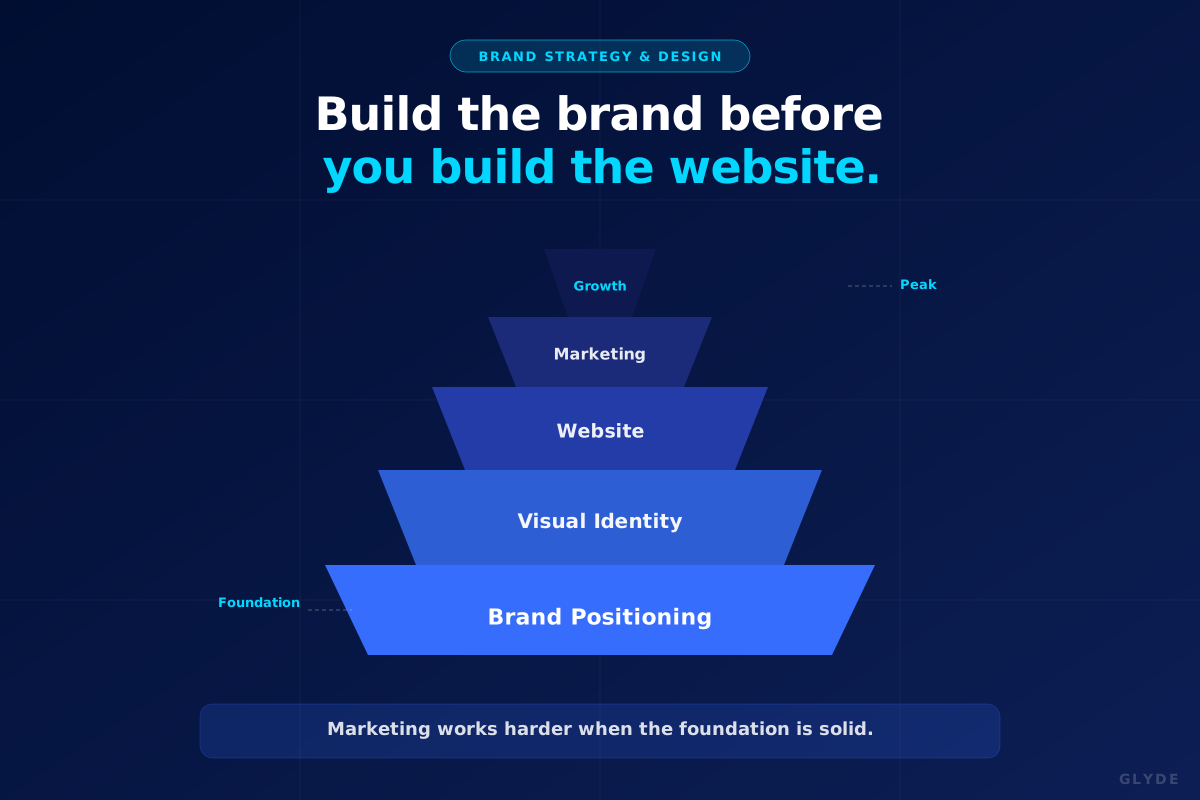
Think of your brand as a structure. The channels — your website, social media, ads, SEO — sit at the top. They only perform when what's below them is solid. Positioning is the ground floor. Visual identity is the next layer up. Everything else is built on those two.
Each layer only performs when the layer beneath it is solid
The website problem
Why websites built without strategy fail
A website built without positioning is a website built on guesswork. The copy ends up vague — "quality service", "trusted partner", "customer-first approach". Every competitor says the same thing. There's nothing to make a visitor stop and think: this is exactly what I've been looking for.
Weak messaging produces weak conversion. And because the problem is strategic rather than visual, no redesign will fix it. The businesses that rebuild their sites every 18 months are usually the ones that launched without the strategy in place first.
A website should express your positioning clearly — not spend its existence trying to discover what that positioning should be.
No brand positioning
Generic, unmemorable messaging
Website visitors don't convert
Ad spend climbs to compensate
Expensive rebuild — and starting over
Social media
Consistency without identity is just noise
Social media rewards brands that show up the same way every time. When there's no visual identity underpinning the content, what you get instead is a feed that looks like it was posted by three different people in three different moods.
The brands people recognise before they even see the logo — those aren't accidents. They're the result of a deliberate visual system applied consistently over time. Consistency builds familiarity. Familiarity earns trust. Trust converts.
The multiplier effect
What happens when you get the foundation right
When positioning and visual identity are in place before anything else, every channel you invest in gets sharper. Not because the tactics change — but because they're finally working from the same brief.
SEO
Content strategy has a clear point of view — topics and keywords are chosen around genuine expertise, not guesswork.
Social media
Every post looks and sounds like the same brand. Recognition builds over time instead of resetting with each campaign.
Advertising
Campaigns lead with a genuine differentiator, not a generic claim. Cost per acquisition drops because the message actually lands.
Website
Messaging is sharp, navigation is clear, and visitors understand the value before they reach the contact page.
Same market, different result
What perception actually does
Two fashion brands. Same price point. Same target market. Roughly the same product quality. Here's why one of them builds a community and the other competes on discount codes.
Fashion Brand A
No defined position
- No clear aesthetic or brand point of view
- Feed looks different week to week
- Copy could apply to any fashion label
- Constantly running promotions to drive sales
- Low repeat purchase, no word-of-mouth
Fashion Brand B
Positioned brand
- Clear: effortless workwear for women who don't want to think about getting dressed
- Consistent palette, tone, and imagery everywhere
- Content speaks to her life, not just her wardrobe
- Sells at full price — loyalty over discounts
- Community grows through referrals and UGC
Same market. Same product. The only difference is clarity. Brand B isn't louder — it's clearer. And clearer always wins.
The right sequence
Build in the order that works
Most businesses treat branding as something to tidy up once they've already started marketing. By then, inconsistency is baked in — and fixing it means undoing work you've already paid for.
Common approach
01Website
02Social media
03Advertising
04Branding← too late
Recommended approach
01Brand positioning
02Visual identity
03Website
04Content · SEO · Ads
The Glyde framework
How we approach it
Every engagement we run at Glyde starts in the same place: positioning. We don't open a design tool until we know exactly who the brand is for, what it's trying to say, and why anyone should care. Everything that follows — design, build, marketing — is faster and more effective because of it.
The Glyde Growth Framework
01
PositionBrand strategy02
DesignVisual identity03
BuildWebsite & assets04
MarketSEO · Ads · Social05
ScaleSustainable growthThe clearest brands win
There's no clever campaign that compensates for unclear positioning. No website redesign that fixes a strategy problem. No amount of ad spend that makes a generic message land.
Get the foundation right first. Define what you stand for, who you're for, and why you're different. Build the visual system that makes it visible. Then invest in the channels that carry it forward.
The businesses that grow without burning money are almost never the loudest ones in the room. They're the clearest.
Ready to build the right foundation?
Glyde works with startups and growing businesses across SEA to define positioning, build visual identity, and launch marketing that converts.
Let's talk →