 Brand Strategy & Design
 Contact Us
How to position your brand in a crowded market
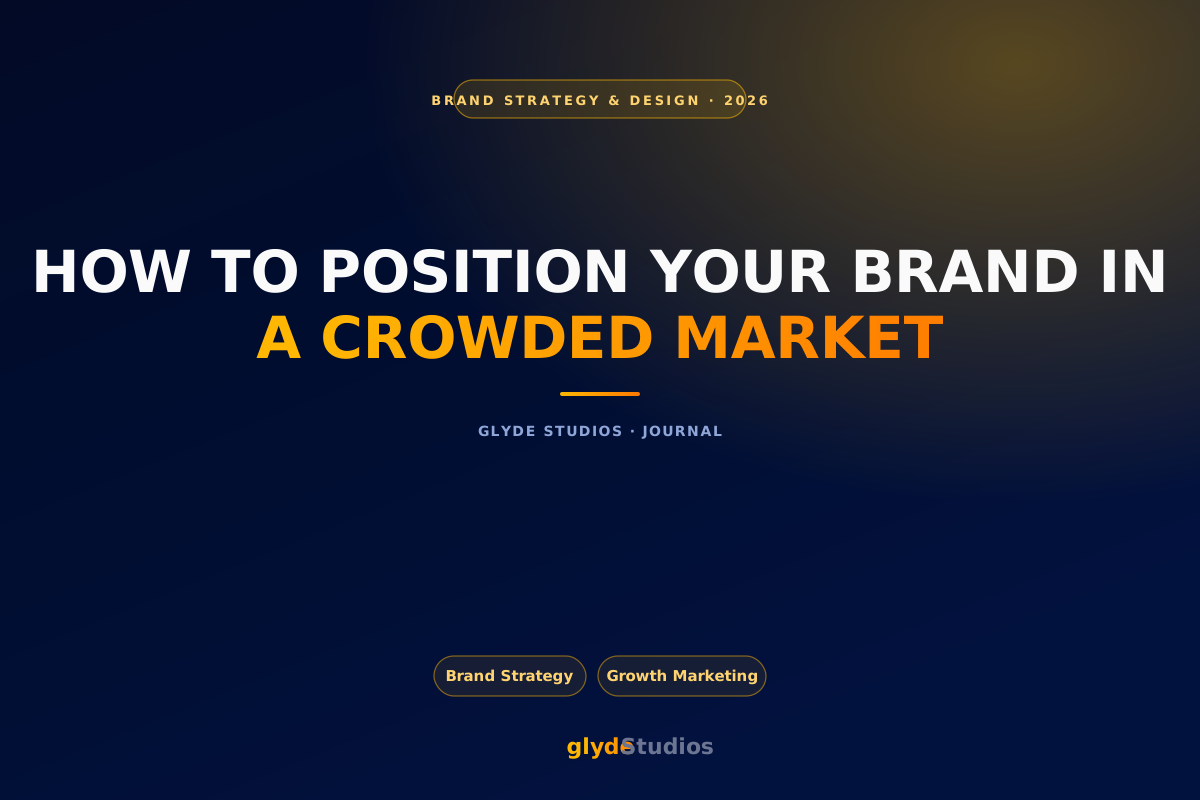
Most brands don't lose to a better competitor — they lose to one buyers can actually tell apart. Here's how to find and defend the position only you can own, backed by what's really driving brand value in 2026.
Most brands don't lose to a better competitor. They lose to a competitor customers can actually tell apart from everyone else. In category after category, the products, pricing, and even the marketing now look interchangeable — which means the brand with the clearest position, not the loudest budget, wins the tiebreak.
Positioning isn't a tagline exercise. It's the answer to one question, held consistently across every touchpoint: when a buyer has your category's alternatives in front of them, why should this one be obvious? Get that answer sharp and specific, and everything downstream — pricing power, sales velocity, referrals — gets easier. Leave it vague, and you're stuck competing on price and ad spend against everyone else in the tab they have open.
71%of Global Top 100 brand value growth since 2006 came from differentiated brands
80%of marketers now use AI to create content — flooding categories with sameness
3 in 4consumers trade down or switch brands once differentiation isn't obvious
Differentiation is where the value concentrates
% share of Global Top 100 brand value growth since 2006
Why sameness is expensive
The market is rewarding difference, not volume
Differentiated, disruptive brands captured more than double the value growth of brands that competed on sameness. At the same time, AI tools are flooding every category with more content than ever, so more brands are saying similar things in similar language at the same moment. Put those two forces together and sameness stops being a branding problem — it becomes a revenue problem, because buyers who can't tell you apart default to price.
The fix
Own one edge, not the whole category
The instinct in a crowded market is to broaden — more features, more claims, more audiences — hoping something lands. It backfires. Brands that break through pick one defensible edge and repeat it until it's theirs: the fastest, the most rigorous, the only one built for a specific buyer. A position only becomes real when it's specific enough that a competitor couldn't credibly claim it too. And it has to be built against the actual alternative a buyer is weighing, not an abstract description of the category — nobody chooses "a project management tool," they choose it over the spreadsheet, the inbox thread, or your competitor's dashboard.
Diagnose your gap
Where to start
Your situationStart withWhy
Selling into a category with 10+ credible competitors
Narrow to one defensible edge
Owning everything means owning nothing
Sales keeps discounting to win deals
Reposition before you re-price
Price wars end where differentiation begins
Messaging tests fine but doesn't convert
Position against the real alternative
Buyers compare you to what they'd do instead
Brand is invisible in AI search results
Sharpen your point of view
AI engines cite distinct claims, not generic ones
Positioning work compounds fastest when it's aimed at the specific place it's currently leaking revenue — pick the row above that matches where you are today.
Where Glyde fits
We build the position, then the brand around it
Positioning isn't a workshop output that sits in a deck. At Glyde, it's the first move in every brand engagement, because design, messaging, and web experience all inherit their sharpness — or their sameness — from the position underneath them.
The Glyde Growth Framework
01
PositionBrand strategy02
DesignVisual identity03
BuildWebsite & assets04
MarketSEO · Ads · Social05
ScaleSustainable growthReady to find the position only you can own?
A clear, defensible position turns "another option" into "the obvious one" — and it's the fastest lever most growing brands haven't pulled yet.
Get a positioning audit →