 E-Commerce Operations
Should I use Shopify, WooCommerce, Shopline or Haravan?
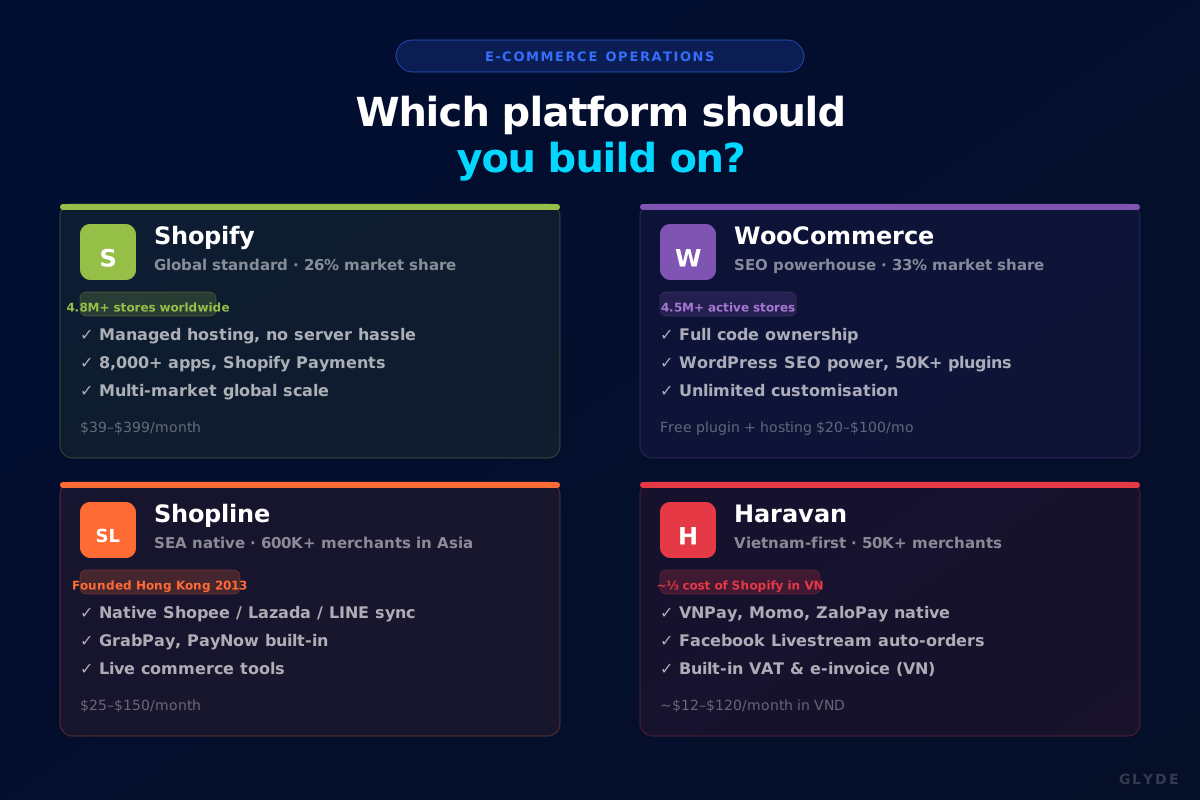
Four platforms. Very different answers depending on where you sell, how you sell, and how technical your team is. Here's the honest breakdown.
We build ecommerce websites for a living. This is the question we get asked more than any other — and it almost never has a universal answer. Each of these four platforms was built for a different merchant, in a different context, with different priorities.
The wrong choice doesn't just slow you down. It compounds — in developer hours, migration costs, and lost SEO equity. So here's the framework we use when a client asks.
There's no objectively best platform. There's only the platform that's best for your specific business model, market, technical capacity, and three-year growth plan.
The four platforms
Know what you're choosing between
Shopify
The global standard for managed ecommerce
Market share
26–29%
~5.6M stores worldwide
Pricing
$39–$399/mo
+ apps + transaction fees
Best for
Speed to launch
Multi-market growth
Managed hosting
8,000+ apps
Shopify Payments
Transaction fees apply
Less SEO flexibility
WooCommerce
The open-source engine for content-led stores
Market share
33–39%
4.5M+ active stores
Pricing
Free plugin
Hosting $20–$100/mo
Best for
Custom builds
SEO-driven growth
Full ownership
WordPress SEO power
Unlimited flexibility
Requires dev resources
You manage hosting
Shopline
Asia's answer to Shopify, built for SEA
Merchants
600K+
Primarily Asia
Pricing
$25–$150/mo
No fees on ShoplinePay
Best for
SEA omnichannel
Local marketplace sync
Native Shopee/Lazada/LINE
GrabPay, PayNow built-in
Social commerce tools
Smaller app ecosystem
Weak outside Asia
Haravan
Vietnam's native ecommerce + omnichannel platform
Merchants
50,000+
Vietnam, Thailand, PH
Pricing
~$12–$120/mo
In VND, VAT included
Best for
Vietnam merchants
Livestream + social commerce
VNPay, Momo, ZaloPay native
Shopee/Lazada/TikTok sync
Built-in VAT & e-invoice
Vietnam-only focus
Limited outside VN
Feature comparison
How they compare across what matters
| Feature | Shopify | WooCommerce | Shopline | Haravan |
|---|---|---|---|---|
| Ease of setup | ●●● | ●○○ | ●●○ | ●●○ |
| SEO capability | ●●○ | ●●● | ●●○ | ●○○ |
| SEA marketplace sync | Via apps only | Via plugins | Native | Native |
| Global scalability | ●●● | ●●● | ●●○ | ●○○ |
| Local payment gateways | Limited in SEA | Via plugins | Built-in SEA | Built-in VN |
| Design customisation | ●●● | ●●● | ●●○ | ●●○ |
| App / plugin ecosystem | 8,000+ apps | 50,000+ plugins | Smaller | Limited |
| Livestream commerce | Via apps | Via plugins | Built-in | Built-in |
| No transaction fees | Shopify Pay only | Yes | ShoplinePay | Yes |
How to choose
The decision guide
If →You want to launch fast with minimal tech overhead and sell globally → Shopify. Managed infrastructure, the largest app ecosystem, and the best multi-market tooling available.
If →You're a content-led brand with a serious SEO strategy or a team with WordPress experience → WooCommerce. The SEO ceiling is higher, and full ownership of your codebase matters long-term.
If →You're selling primarily in Southeast Asia and need native Shopee, Lazada, LINE, and GrabPay integration without stitching apps together → Shopline. Built for this market from the ground up.
If →You're operating in Vietnam specifically — with customers paying via VNPay or Momo, shipping via GHN, and buying through Facebook Live → Haravan. A fraction of Shopify's price and native to how Vietnamese commerce actually works.
If →You're a brand with regional ambitions beyond one country → Shopify or WooCommerce first, with Shopline as a parallel SEA channel where marketplace integration matters most.
The platform you build on in 2026 will carry your catalogue, your customers, and your revenue. Pick for where your business is going — not just where it is today.
The hidden cost
Total cost is never the sticker price
Every platform looks cheaper before you're actually live. Apps, plugins, developer time, marketplace connector fees, and transaction charges all stack on top of the headline subscription. Before committing, model your fully-loaded monthly cost at your current volume — and at two times your current volume. The answer often changes the decision.
The Shopify–WooCommerce cost crossover happens around $200K–$500K in annual revenue, where WooCommerce's hosting and developer costs start competing with Shopify's transaction fees. Shopline and Haravan stay structurally cheaper than Shopify for SEA merchants — but at the cost of a smaller ecosystem and weaker global infrastructure.
The headline subscription is rarely more than the first layer of the true monthly cost
Where Glyde fits
Platform strategy is part of what we do
We don't have a preferred platform. We have a preferred outcome: a website that loads fast, converts well, and supports how your business actually generates revenue. That sometimes means Shopify. Sometimes WooCommerce. For SEA-first brands, often Shopline. For Vietnam-based merchants, often Haravan.
Glyde's development team is experienced across all four. We run platform selection as part of every engagement — before a line of code gets written.
The Glyde Growth Framework
01
PositionBrand strategy02
DesignVisual identity03
BuildWebsite & assets04
MarketSEO · Ads · Social05
ScaleSustainable growthSources & references
- WooCommerce vs Shopify Market Share 2026 — Mobiloud (2026)
- WooCommerce Market Share 2026 — Red Stag Fulfillment / StoreLeads (Aug 2025)
- Shopify vs WooCommerce 2026 — Tech Insider (Apr 2026)
- Shopify vs WooCommerce: The Honest Truth — LetsMetrix (Apr 2026)
- Shopify vs Shopline in Asia — EasySell (May 2026)
- Shopify Plus vs Shopline in SEA — Branch8 (Apr 2026)
- What Is Shopline — MediaOne Singapore (Mar 2026)
- Shopify vs Haravan — EcommerceCEO (Jun 2026)
- Shopify vs Haravan: Which Platform is Right for You — WebAppMeister (Feb 2026)
Not sure which platform is right for you?
Glyde runs platform selection and total cost modelling as part of every ecommerce engagement across SEA, so you build on the platform that fits how your business actually sells.
Let's talk →