
 E-Commerce Operations
The state of Southeast Asia e-commerce in 2026
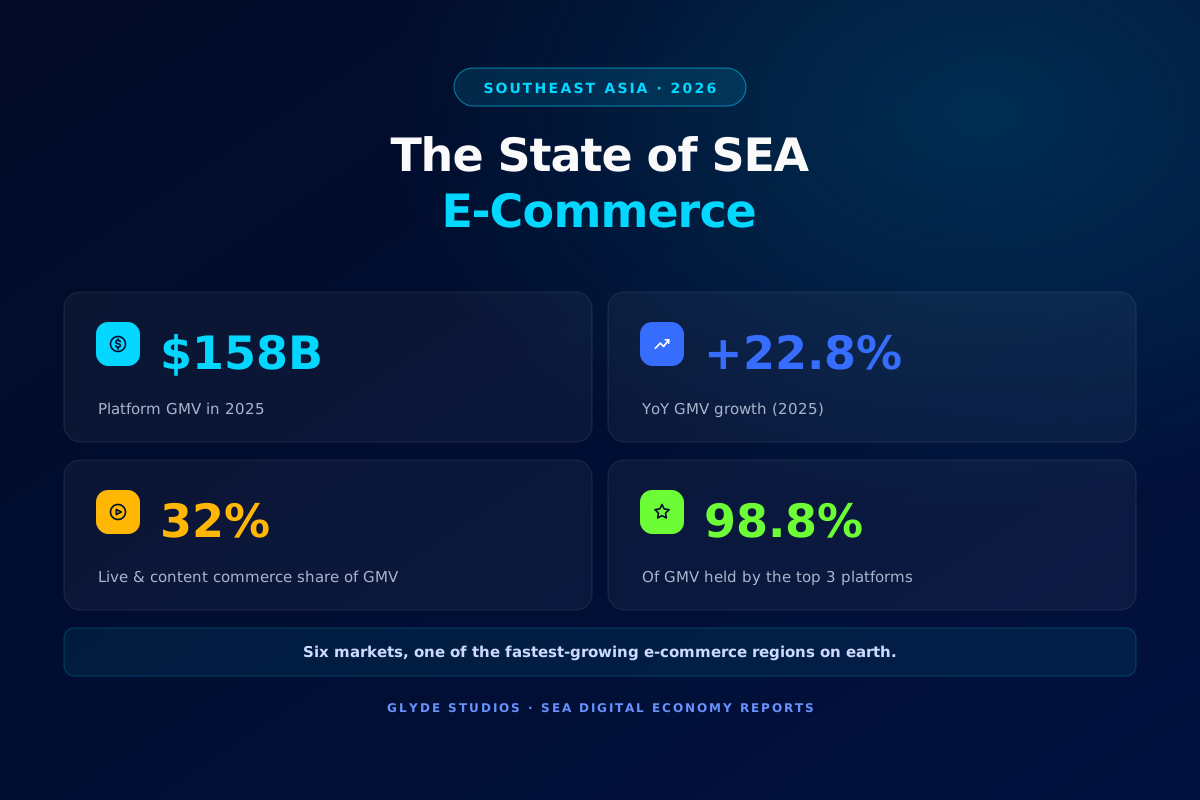
Southeast Asia's platform e-commerce grew 22.8% last year to US$157.6 billion — its fastest pace in four years. But the real story isn't the size. It's how the region now shops: live, mobile-first, and increasingly on a shortlist of just three platforms. Here's where things stand, and what it means for brands selling into the region.
For years, "Southeast Asia is growing" was enough of an insight. Not anymore. The region's digital economy crossed US$300 billion in GMV in 2025, with e-commerce alone approaching US$185 billion — but growth is no longer evenly spread. Content commerce is exploding, consolidation is squeezing out smaller players, and each of the six core markets is moving at its own speed. Reading the map correctly is now the difference between scaling and stalling.
$157.6B2025 platform GMV across the six core markets
+22.8%YoY growth — the fastest in four years
32%of platform GMV now from live & content commerce
Three platforms, almost the whole market
Share of SEA platform GMV, 2025
What changed
Four shifts defining 2026
Beneath the headline numbers, four structural forces are reshaping how — and where — the region buys.
01The forces reshaping the region
1
Live & content commerce went mainstream
Video-led shopping generated ~US$49.7B — 32% of platform GMV, up from 20% a year earlier. Discovery now happens in a feed, not a search bar.
TikTok Shop
Shopee Live
2
Consolidation around three platforms
Shopee, TikTok Shop and Lazada now hold ~98.8% of GMV. For single-market challengers, the runway has all but closed.
Shopee
Lazada
3
Growth shifted to the "second tier"
Thailand (+51.8%) and Malaysia (+47.6%) grew fastest, while Indonesia — still the largest at ~37% of GMV — cooled amid competitive shifts.
Regional data
Google Analytics
4
Profit, not just GMV, became the goal
Platforms trimmed subsidies and chased margin. Sellers who leaned on discounts alone felt it first — operations and retention now decide who wins.
Shopify
Zapier
The takeaway: Southeast Asia is no longer a single "emerging" market to check off. It's six distinct markets, three dominant platforms, and one clear direction of travel — toward video, mobile, and disciplined operations.
Play the map
Where to start
Your goalStart withWhy
Entering the region
Indonesia or Thailand first
Largest base, fastest growth
Reaching Gen-Z buyers
TikTok Shop + live selling
Where discovery now happens
Maximising reach
Multi-platform on Shopee
53% share, all six markets
Protecting margin
Retention + AOV, not discounts
Subsidy era is ending
You don't need to be everywhere. Win one market and one platform properly — with tight operations and a real content-commerce motion — before you expand.
Where Glyde fits
We build for the region, not just for launch
Selling into Southeast Asia isn't a translation job — it's an operations job. Different platforms, payment habits, logistics, and content expectations in every market. At Glyde, we help brands position for the region, build the storefronts and integrations, and run the growth loop that turns a launch into sustained revenue.
The Glyde Growth Framework
01
PositionBrand strategy02
DesignVisual identity03
BuildWebsite & assets04
MarketSEO · Ads · Social05
ScaleSustainable growthReady to sell into Southeast Asia?
Glyde builds and operates e-commerce that's tuned for the region's platforms, buyers, and margins.
Talk to our commerce team →Sources & references
- Southeast Asia's platform ecommerce reaches US$157.6B in 2025 — Momentum Works / The Low Down (2025)
- e-Conomy SEA 2025: ASEAN's digital economy to surpass $300B in GMV — Google, Temasek & Bain & Company (2025)
- Shopee, Lazada, and TikTok Shop in Southeast Asia: what the data shows in 2026 — Cube Asia (2026)