 UI/UX Design
Are web designers obsolete with the rise of AI?
We build websites for a living. So when AI website builders started generating "complete" sites from a single text prompt, we paid close attention.
Here's our honest take: AI has made the production of websites dramatically faster. It has not made the strategy, thinking, and judgment behind those websites any less necessary. In fact, it's made it more important.
93%Of web designers use AI tools in their workflows
85%Believe learning to work with AI is essential to their future
$61BProjected global web design market value in 2025
The honest verdict first
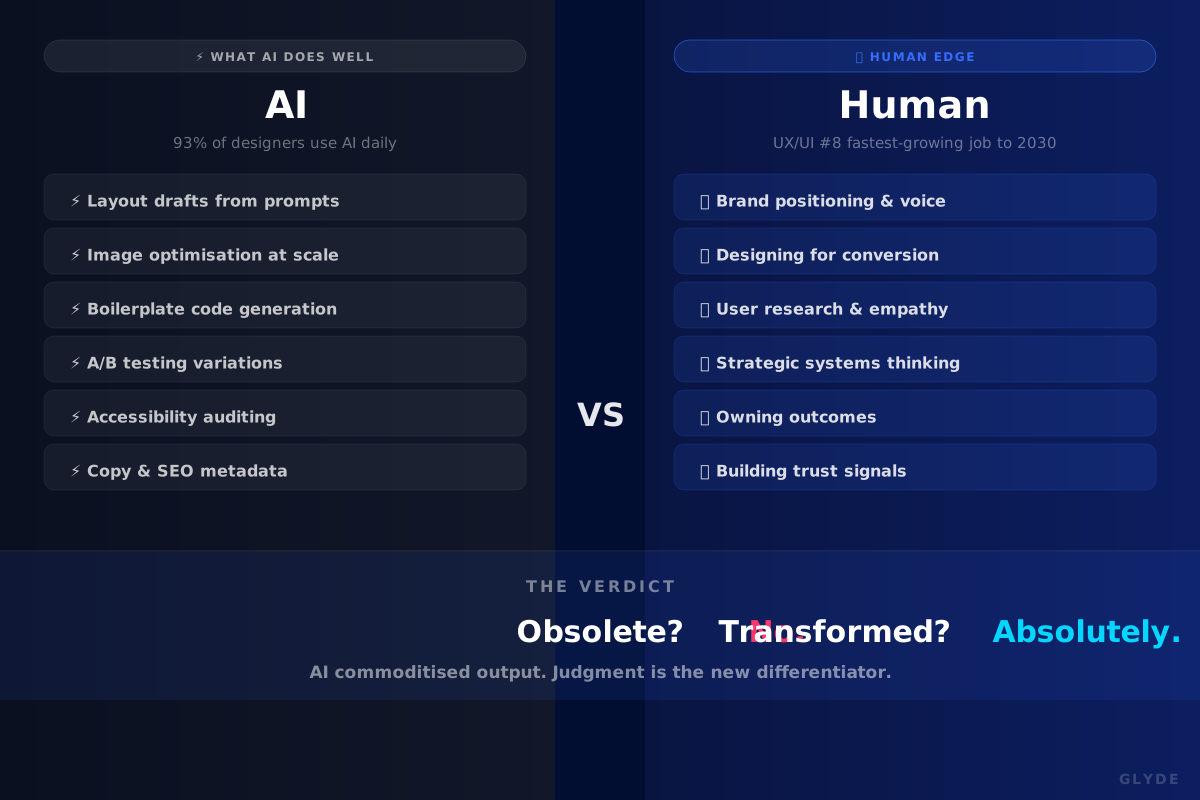
Obsolete? No. Transformed? Absolutely.
The role of a web designer hasn't disappeared — it's shifted upstream. The value is no longer in the ability to push pixels or write boilerplate code. It's in knowing why a layout should work, for whom, in service of what business goal. That's the part AI still gets consistently wrong.
What AI actually does well
Where AI earns its place
AI tools are genuinely exceptional at compressing the time cost of repetitive, production-level work. The honest breakdown — what AI alone handles versus what still needs a designer in the loop:
AI alone
Handles this well
- Generating responsive layout drafts from prompts
- Resizing, compressing, and optimising images
- Writing and refining boilerplate code
- Flagging accessibility issues (alt text, contrast)
- A/B testing variations at scale
- Generating copy variations and SEO metadata
Designer + AI
Still needs a human
- Understanding brand positioning and voice
- Designing for conversion, not just aesthetics
- Applying real user research and empathy
- Navigating client goals vs user needs
- Building trust through deliberate design choices
- Owning outcomes, not just producing artefacts
The numbers tell both sides
AI adoption vs AI trust
The data captures the tension well. AI use is near-universal, but trust in AI output remains cautious — and for good reason.
| Metric | Finding | Source |
|---|---|---|
| AI tool adoption | 93% of designers use AI tools in their workflows | Gauss / Web Designer Depot, 2025 |
| Efficiency gains | 78% say AI boosts their work efficiency | Figma State of Design, 2025 |
| Trust gap | 40% don't yet trust AI-generated outputs fully | Figma, 2025 |
| Business impact | 75% say AI competition has already hit their business | 20i Study, Apr 2026 |
| Job growth | Digital designer employment projected +7% through 2034 | US Bureau of Labor Statistics |
| Future of jobs | UX/UI Designer ranked #8 fastest-growing role to 2030 | WEF Future of Jobs Report, 2025 |
The same report that shows 75% of designers feel AI pressure also shows the web design market growing to $61.23 billion. The problem isn't demand. It's who captures it.
Where human value sits now
The edge that doesn't get automated
The designers and studios that are winning right now aren't the ones ignoring AI. They're the ones who've understood what AI cannot replicate — and doubled down on it.
Brand strategy
AI can generate a layout. It can't determine whether that layout serves a brand that should feel premium, approachable, or disruptive. That requires positioning work done upstream.
Conversion thinking
A beautiful AI-generated page can still be completely wrong for conversion. Understanding why visitors hesitate, trust, or leave is a human skill built from real project experience.
Systems judgment
AI produces components. Designers build systems — the rules, hierarchies, and relationships that make a brand coherent across every touchpoint over time.
Strategic ownership
Clients don't hire designers to produce files. They hire them to be accountable for outcomes. AI tools don't take responsibility for a website that doesn't convert.
The real shift
From maker to decision-maker
The designers who are struggling are those whose entire value was tied to production: making the thing look right, at the right pixel size, in the right export format. AI has largely automated that. The designers who are thriving have moved upstream — into brief-writing, positioning, conversion architecture, and client strategy.
At Glyde, we've always built websites that answer a business question, not just a design brief. AI has made our production faster. It hasn't changed what the work is actually for.
The Glyde Growth Framework
01
PositionBrand strategy02
DesignVisual identity03
BuildWebsite & assets04
MarketSEO · Ads · Social05
ScaleSustainable growthSo, are web designers obsolete?
No — but the job description has changed for good. AI replaced the production line, not the thinking. The designers who treated pixels as the product are feeling the squeeze. The ones who always treated design as a business decision have never been more valuable.
The market is still growing. The demand is still there. The only question is whether the work that captures it is human-led — or generic by default.
Sources & references
- 40+ Statistics on AI in Web Design — Gauss.hr (2025)
- 60+ Web Design Statistics for 2026 — Figma (2025)
- 75% of web designers now fear AI more than shrinking budgets — TechRadar / 20i Study (Apr 2026)
- Will AI Replace Web Designers in 2026? — Craft & Root (Mar 2026)
- The UX Job Market in 2026 — UX Design Institute (Mar 2026)
- State of UX 2026 — Nielsen Norman Group (Mar 2026)
- Why the UX Job Market is Changing in 2026 — UX Planet (Jan 2026)
- UX/UI Designer #8 Fastest-Growing Job to 2030 — WEF Future of Jobs Report via Source.paris (2025)
Want a website built with strategy, not just software?
Glyde pairs a human design team with AI-accelerated production — so you get judgment and speed without compromising either.
Let's talk →